
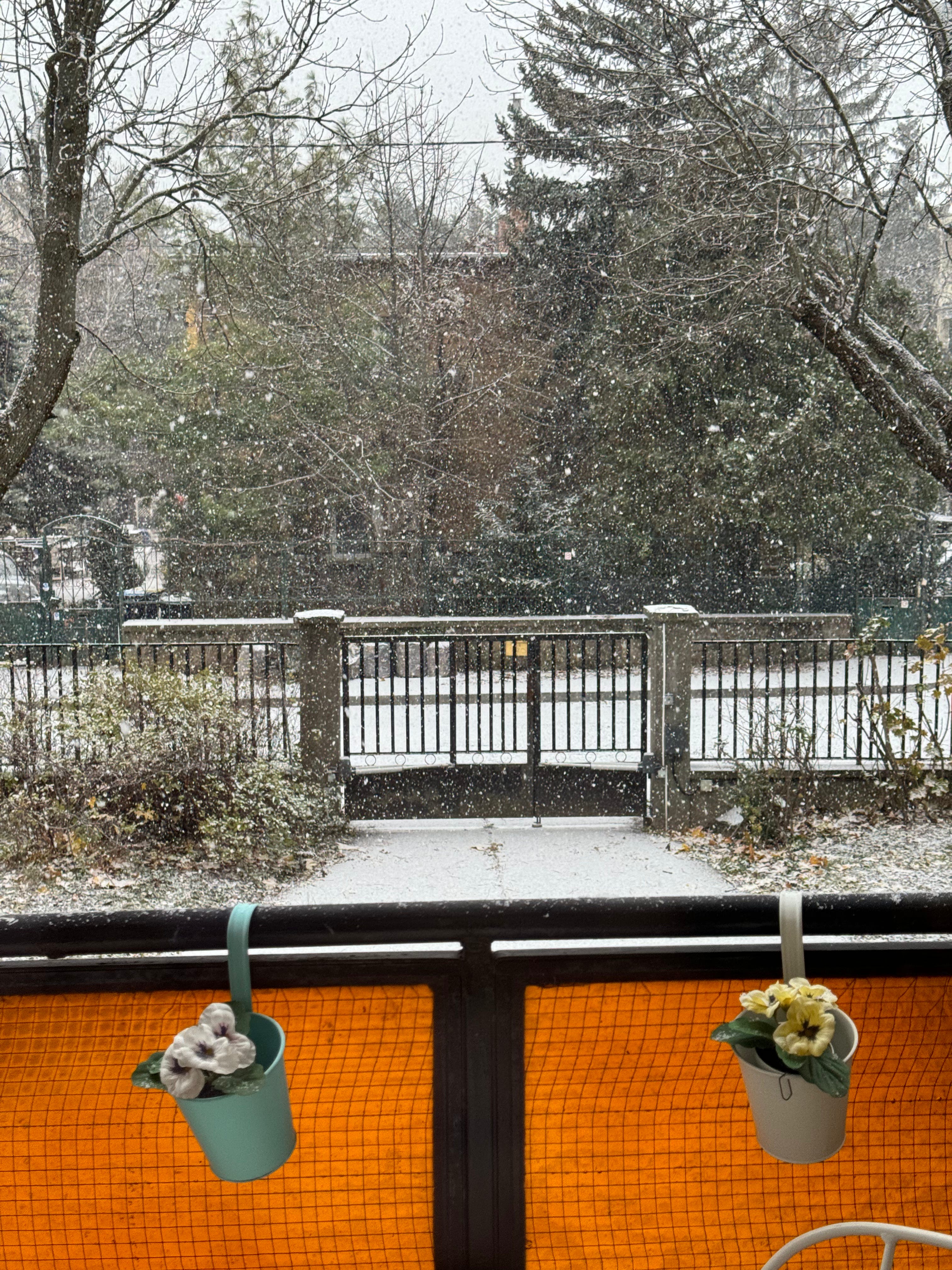
Good morning. It’s November 30th, about 9:45 AM. It’s snowing outside.
I’m standing at the window looking across my balcony as snowflakes collect on the plastic leaves of the fake pansies hanging on the balcony rail, and in the yard and courtyard beyond. Really accumulating — sticking to the sides of the trees on all sides, depending on which way the branch is pitched. If the trunk is leaning north and has one side facing south, the snow clings to that side. Not uniform, as you might imagine. The pine trees, the boughs collecting a heavy coat. It’s winter. It’s downright wintry.
It’s a good day to be driven inside — except my parka is set to be delivered to the collection box at the supermarket down the way. So I might have a wintry walk ahead of me at some point.
Yesterday I got — I don’t know — kicked in the soul, but not in a bad way. More of a motivational kick to the soul. It was the culmination of a few things. The culmination of my first week here, and also the culmination of the documentary film festival that started the day I got here. I’ve seen several films this past week. I don’t think I’ve seen that many docs in the past year.
There’s a distinction between the types of docs you see at a film festival and my more common documentary fare — what’s available on the streamers. A lot of them are good, but they’re definitely commodities. The stuff you see at film festivals are the stories that people have really bled for. It was a good reminder of the difference, especially since I’ve been living in the epicenter of commodity storytelling. And I don’t say that as necessarily a bad thing, but that’s what Los Angeles is. If the stories you want to tell don’t fit the mold for what is the popular commodity at the time, it’s very difficult to share them with the world. The system also produces a lot of art, but it’s not inclined toward the art. The art isn’t enough.
Projects at a European film festival get financed much differently. The overall development lifespan of a documentary is a lot different from what I’m accustomed to in Los Angeles. So you get stories that people have told because they either personally needed to tell them, or because they’re stories the world needed to see.
In that latter category: 20 Days in Mariupol. Just saying it out loud puts a lump in my throat. It was one of the most difficult things I’ve ever watched. An absolutely unfiltered look at what war and invasion — and especially attacks on civilians — looks like. What it does to a city, to a community of people. Taking them from everyday life to a besieged city. Unimaginable, but important. Vital for the world to see.
Then last night I saw one that was the other end of the spectrum. Just absolute art. Apollonia, Apollonia. A Danish filmmaker followed a painter she met in Paris in 2009 or 2010, and she followed her for 13 years. It started as just picking up a camera and focusing it on a compelling character she’d met. I don’t think she ever imagined it would turn into a 13-year journey. But it did. And the filmmaking is extraordinary — both because of the intimacy of the story and the portrait of an artist. Up close and personal. Anybody who’s either an artist or pursuing a dream will find so much in it that’s relatable. An extraordinary, utterly human story. The struggle artists face. And the composition and contribution of the filmmaker herself — second to none.
What it got me thinking about was single-mindedness. The single-mindedness of so many craftsmen and artists I admire — the single-mindedness of pursuing one’s craft. That requires assuming a fairly narrow lane, at the exclusion of a lot of other things. One of my shortcomings, as I’ve developed my own crafts, has been an inability to exclude things that compromise my ability to stay focused on my art. And that’s part of why I made this move. As much an escape from my own tendencies as it was a need to geographically relocate.
These documentaries. It’s so weird that I got here right in time for this festival. Five different docs over a week, and it really got me thinking about the difference between the artful side of storytelling and projects that spring from skill and capability. I look back on my work from the last ten years and I can divide it into two categories: projects I produced because I’m skilled, and projects I produced for the art of it. The main difference being that certain stories spring from my heart — an urgency, a need to tell them. Others are stories that, by producing them, I sustain myself. I support a campaign. I deliver a deliverable. That doesn’t mean the deliverable isn’t important. I’ve done a lot of work around social justice and reform issues that I believe in. But those are issue stories. And that kind of storytelling has served me well. But if I had to choose — and I can, and I should — the next ten years of my storytelling has to focus on whatever springs from my heart. I’ve never really explored that.
That’s one of the things that hit me, reflecting on this story of an artist who invested years of her life into telling one story visually. Making creative choices day in and day out, year in and year out. A craft driven from the heart.
Slowing down. Even in something as granular as how you set up a shot — the most expeditious and lazy version is sit somebody in a chair and interview them. That’s great for news doc. But it’s not natural. It’s not organic. At a macro level. But if you pull back, I start thinking about the Ukraine project. What’s calling me to go deeper is an interest in how creative souls are living, functioning, and creating during this time of war. There’s something in what I’ve seen among those people — something really endearing and compelling and heartfelt. As a storyteller, part of my muscle memory is to go to the expeditious mode: capture their narrative concisely, shoot artful footage that complements it. But that’s not the kind of doc I would want to watch about this. I want something that fuses the two — very grounded and intimate, but springs from a more verité approach to capturing their lives and these moments in time.
Anyway. That’s probably enough ramble for now. But it’s what I’ve been thinking about, and it’s how these docs have made an impression on me. Kind of jolted me. In a good way.
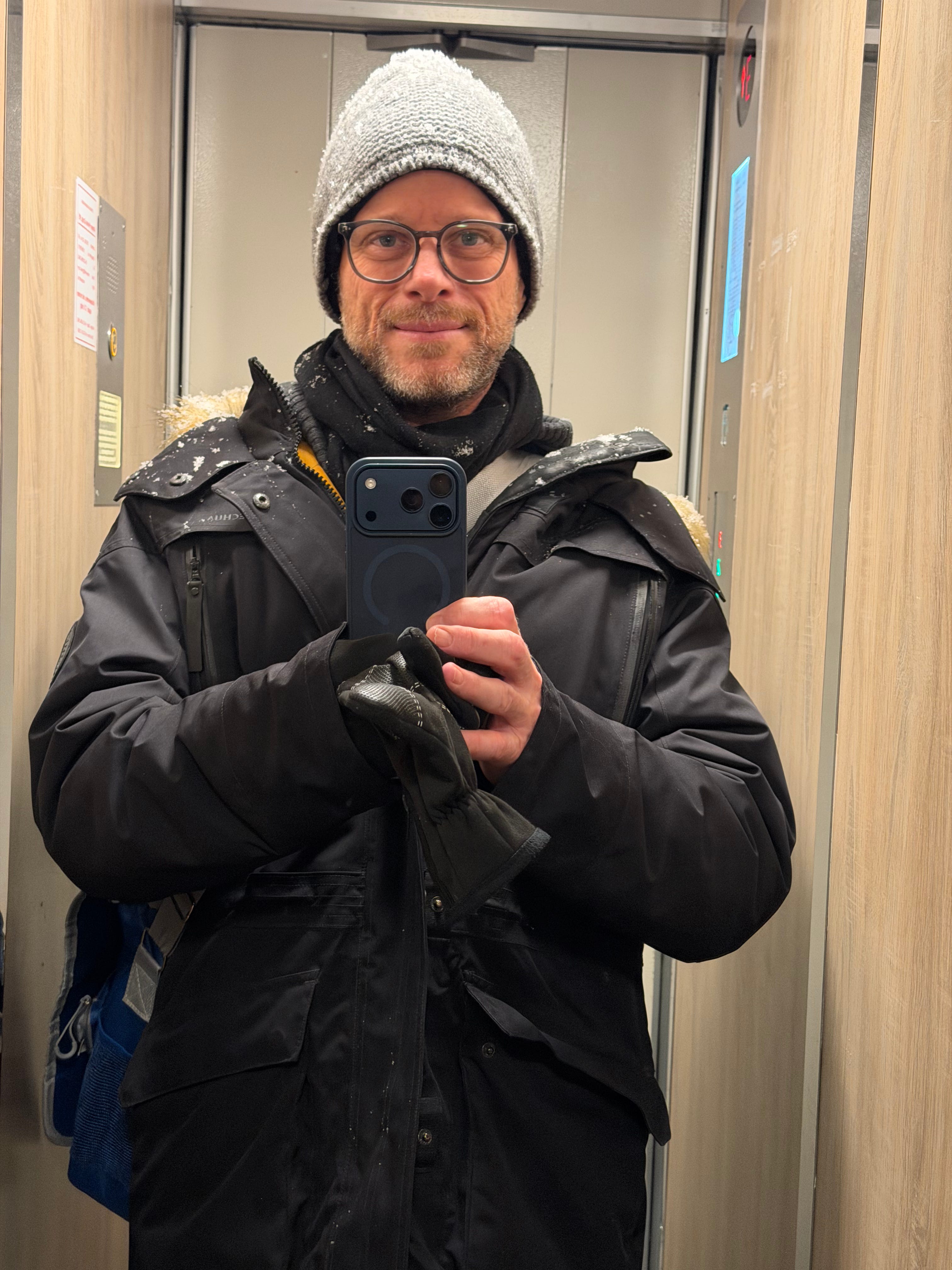
The snow is still falling. Big, giant, heavy flakes. I remember reading once that when you start to see the big heavy flakes, it means the snow is going to stop soon. I started noticing that after I read it, and I think it’s held true. Though maybe that was about American snow.
The interesting thing is that now when I see big heavy flakes, it gets me down a little — because I want it to keep snowing. It’s early in the season, I don’t have to shovel, and I’m not a jaded adult. Because when I was a kid, I wanted it to snow all day. I wanted school cancelled. I wanted a nice thick layer on the sledding hill. Falling snow is joy when you’re a kid. Just wonderful. And we lose that. We lose it because we associate it with all the friction and resistance that comes with a heavy snow in modern life.
But that’s not what you pay attention to when you’re a kid.
So I’m not going to pay attention to it either.